April 2016
The SISKIN
Newsletter of the Northern Virginia Bird Club
Vol. 61, No. 2
April 2016
Inside
Calendar of NVBC field trips April 13 – June 25, 2016
VSO Annual Meeting, April 29-May 1
Virginia Breeding Bird Survey Atlas Project
Birding Madness – The Birdathon
Report and photos from NVBC 2016 winter weekend trips
Birding in Minnesota
Mating Barred Owl photographs
Book Notes
Upcoming Weekend Trips: Spring Chincoteague Weekend
The Chincoteague Spring Weekend club trip is scheduled for May 20-22 (Friday-Sunday). Mid-May is an excellent time to visit the Chincoteague National Wildlife Refuge (NWR); spring shorebird migration is in full swing with most birds in breeding plumage. Last year’s trip tallied nearly 100 species including such Eastern Shore specialties as Black-necked Stilts, American Oystercatchers, Piping Plovers, Whimbrels, Marbled Godwits, Little Blue and Tricolored Herons, Cattle Egrets, Glossy Ibis, Least, Royal and Common Terns, Black Skimmers, Clapper Rails, Seaside Sparrows, Chuck-will’s-widow, Brown-headed Nuthatches and Boat-tailed Grackles. Our best sightings were an American Golden Plover and a White-faced Ibis. We will also be searching for Gull-billed Terns – a bird we missed last year.
+4
Plans for the weekend include birding the Chincoteague NWR on Friday afternoon starting at 3:15 pm (optional) and on Saturday starting at 7:30 am. Activities on Saturday morning include birding along Beach Road, Swan Cove and Tom’s Cove and a walk along the Woodland Trail looking for land bird migrants. On Saturday afternoon, we may reserve the Chincoteague Natural History Association’s bus for a 90 minute trip to the Wash Flats which provides a look at territory otherwise inaccessible by vehicle. Time permitting, we will also visit the Queen Sound Flats, the Chincoteague City mudflats and Mariner’s Point. On Sunday morning, we will board a boat and travel around Queen Sound looking for shorebirds along the mudflats and sparrows along the marsh edges. The cost of this trip will be $33 per person. If the boat trip is not possible, we will visit Saxis Wildlife Management Area. The trip concludes at noon on Sunday.
+4
NVBC membership is required for this trip. To sign up for this trip, call or email Marv Rubin (703-915-7545 or mbrubin@verizon.net). The trip is limited to 28 people and usually fills up, so please contact Mary Rubin first to ensure that space is available before making hotel reservations. When signing up, please indicate whether you are interested in the Wash Flats bus trip (fee) on Saturday afternoon, the boat trip (fee) on Sunday morning and a Saturday evening group dinner. If the trip is full, your name can be put on a waiting list.
+4
We have obtained a special rate of $94.99 per night on twenty rooms for Friday and Saturday nights at the Best Western Chincoteague Island Hotel on Maddox Boulevard. A two-night stay is usually required. Hotel reservations must be made by April 21 to get this special group rate. Participants should make your own reservations by calling 800-553-6117 and be sure to say you are with the Northern Virginia Bird Club. Check-in time is 3 pm on Friday, May 20, and a 72-hour cancellation notice is required. Chincoteague NWR is a US fee area. — Mary Rubin
+4
NVBC General Meeting — Wednesday, April 20, 8 PM
American Kestrel Nest Box Project …If We Build Them, They will Come!!
Speakers: Patti Reum and Dan Bieker
The American Kestrel’s population has declined because of loss of grassland on agricultural fields. The Virginia Society of Ornithology (VSO) is sponsoring the American Kestrel Nest Box Project to provide nesting boxes in suitable habitat throughout Virginia. Patti Reum and Dan Bieker are members of the VSO Conservation Committee that is carrying out the project. Their presentation will include project photographs, information on the habitat and biology of this fascinating and valuable species and the monitoring program initiated to track the kestrel nesting success using the boxes.
Patti Reum has been involved in many bird projects in Virginia, including working with Center for Conservation Biology biologists on the Golden Chase Project where a Golden Eagle was trapped and fitted with a telemetry device and its migration was followed for four years. She worked as a wildlife biologist in Canada, Maryland and Virginia and also taught math and science for 18 years. Now retired, she spends much of her time working on the kestrel project and helping out with other bird projects. She is the Vice President of the Bath Highland Bird Club.
+3
Dan Bieker is a farm owner and adjunct professor at Piedmont Virginia Community College in Charlottesville, where he teaches Field Ornithology and Appalachian Ecology. He has been involved with kestrel research and nest boxes for over 30 years and builds the boxes for the VSO project in his workshop.
+1
Note: Patti and Dan are willing to bring nest boxes to the program for volunteer hosts. Best nest box location is an open area, preferably 4 or more acres with short ground cover and scattered trees. Contact Dave Farner at 443-643-6141 to coordinate in advance.
+2
Early bird refreshments start at 7:30 pm. Any contributions of food or beverage will be most gratefully received. There will be a drawing for door prizes. Northern Virginia Bird Club pins will be available for members who would like to buy them ($5 each).
+2
MEETING PLACE: St. Andrews Episcopal Church, 4000 Lorcom Lane, Arlington, 22207.
Presidential Peentings
For me, spring is like the Superbowl for birders. As the weather warms, everything outside starts to wake up. Birds that we have not seen since last fall start to arrive. Some stay to breed, but some are just passing through. Many birds, especially warblers can be seen in their full spring regalia. Some can only be seen for just a couple of weeks, however. This is your only chance this year to see a male Blackburnian Warbler in his full glory unless you travel to his breeding grounds.
+4
I like to predict which species of migrating bird will be my next FOY (First of the Year). The birds usually show up on schedule. For example, Ospreys generally first arrive at the very beginning of March. Sure enough, my first Osprey of 2016 was at Occoquan Bay NWR on March 1. The spring is also the perfect time to study bird songs since the avian chorus can fill the sonic landscape, especially in the early morning. Breeding birds are fun to watch as they engage in courtship and then set up housekeeping by building nests in preparation for the arrival of their offspring.
Because of all of this action in the spring, we birders hold a variety of events to take advantage and celebrate the birds. There are birdathons such as the one organized by the Loudoun Wildlife Conservancy, bird festivals such as the Biggest Week in Birding, International Migratory Bird Day, the National Park Bioblitz, and of course the many NVBC bird walks. — Larry Meade
+2
Highland County Weekend
Our summer trip to Highland County in the mountains of western Virginia, led by Marv Rubin, is scheduled for the week-end of May 27-29 (Friday-Sunday). The trip limit is 16 people. Headquarters will be at the Highland Inn in Monterey. We will start the trip at 3:15 pm on Friday afternoon with a drive around the Blue Grass Valley to look for Bobolinks and Vesper Sparrows. On Saturday morning, we will go to Paddy’s Knob to look for Mourning Warblers and Least Flycatchers. On Saturday afternoon and Sunday morning, we will bird other areas of the county. We will arrange a group dinner at either Highland Inn’s dining room or Hap’s High’s Restaurant on both evenings. The trip will end in Monterey at about noon on Sunday. Call or email Mary Rubin (703-915-7545 or mbrubin@verizon.net) to sign up and get information to make your reservations. NVBC membership is required for this trip. — Mary Rubin
+4
The Second Virginia Breeding Bird Atlas Project (VABBA2)
The VSO is partnering with the Virginia Department of Game and Inland Fisheries to prepare the second breeding bird atlas. It will be carried out over the 2016-2020 breeding seasons. Go to the Virginia Birds website to learn about the project and its importance. It has been over 25 years since the first atlas was completed. Volunteers and donations are welcome.
Birding Madness: The Birdathon
Each year thousands of people participate in birdathons across the US. The term “Birdathon” was coined by Bird Studies Canada in 1976 to describe a fundraising event in which participants solicited pledges for the number of bird species they count during a 24-hour period. Birdathons combine competitive birding and fundraising. The most famous is undoubtedly the World Series of Birding organized by the New Jersey Audubon Society. Achieving 220 species in a day may make you the winner. Lately, the Cornell Lab of Ornithology set a Big Day record of nearly 300 species (they got 296).
+4
Locally various teams are active with birdathons. The NVBC’s Wandering Siskins participated in irruption years and out in Loudoun County, the Shrike Force and Raven Loonatics have been battling it out for supremacy, bragging rights, and raising funds for bird conservation efforts. Having participated in six birdathons in Loudoun County, I was curious about the number of species seen. My team, the Raven Loonatics, averages about 115 species a year. Not bad for running around just over 16 hours in a single day. A tally across all years showed an amazing 160 species. That number was a big surprise. Twenty-seven species were recorded only once (Black Duck, Woodcock, Chestnut-sided Warbler, Dickcissel) whereas 77 species were seen each year. The best bird varies by year. Reviewing these records give you a nice perspective on the variety of birds that pass through that are changing.
+4
Chincoteague Winter Trip: American White Pelican and Harlequin Ducks
The Northern Virginia Bird Club visited the Chincoteague National Wildlife Refuge (NWR) and the Chesapeake Bay Bridge and Tunnel (CBBT) Complex on the weekend of February 5 to 7. The trip was led by Marc Ribaudo and me. We collectively tallied 110 species for the trip. Like last year, Friday afternoon was cold and windy. The group drove around Snow Goose Pond noting hundreds of dabbling ducks and Tundra Swans. At dusk, we went to the boardwalk just outside the hotel scouting for Clapper Rails. We heard about a half dozen of them and managed to briefly see one swimming across the estuary.
+4
Saturday featured perfect weather—clear skies and virtually no wind. Marc and I returned to the boardwalk early to scout, finding a mixed species flock of sparrows along the edge of the salt marsh, picking out Nelson’s, Saltmarsh and Seaside Sparrows. Unfortunately, when the full group joined us, we managed to see only the Saltmarsh Sparrow. Recent storms had washed out the beach parking lots, so we set out on a walk from the Tom’s Cove Visitor Center towards the mudflats off the southern beach arm. We spotted a Snow Geese flock roosting along the shore but no other interesting geese. We did find a small flock of sharp-looking Long-tailed Ducks as well as Bonaparte’s Gulls and Forster’s Terns in Tom’s Cove. While sifting through the Dunlins and Willets, we found several Semipalmated Plovers and Western Sandpipers. We were also delighted to find a pair of Horned Larks on the dunes. We had a quick flyover of a Tricolored Heron. A visit to central Chincoteague Island yielded six Eurasian Collared-Doves hanging out with the grackles and starlings near a house with feeders.
+4
Sunday morning’s birding started at Kiptopeke State Park. As we were enjoying excellent looks at Common and Red-throated Loons, a Common Goldeneye and many Red-breasted Mergansers, someone yelled out “pelican!” I was surprised to see an American White Pelican above our heads. The pelican continued riding the wind south towards a tall cell phone tower, circled the tower a few times, then disappeared. Sunday’s escorted visit to the CBBT was very successful. At island #4, we found Surf and Black Scoters, Long-tailed Ducks, Great Cormorants, Purple Sandpipers and plenty of Northern Gannets. On island #3, we found two male Harlequin Ducks accompanying a female very close to the rocks. At one point, one of the males hauled himself up upon the rocks to pose for us. A Cooper’s Hawk with a full crop was flushed from the rocks; presumably the bird had just dined on a sandpiper or a pigeon. Just before a large container ship sailed by, we briefly spotted a distant Razorbill in the rough waters between island #1 and #2. By the time we got to island #1, the wind was howling and not much was found here, but we departed knowing that we had had a very successful trip. — Elton Morel
+4
Highland Winter Trip
Fourteen members of the Bird Club participated in the 2016 Highland County winter bird trip, seeing a total of 54 species across four counties. The trip started in Staunton, VA Friday, March 4 at 1 pm with a local birder, Allan Larner, leading the group to several spots in the Staunton and Harrisonburg areas (Staunton and Rockingham Counties) with spectacular birds. Highlight species of the afternoon were Greater White-fronted Goose, immature Trumpeter Swan, Mute Swan, Greater and Lesser Scaup and Horned Larks.
+2
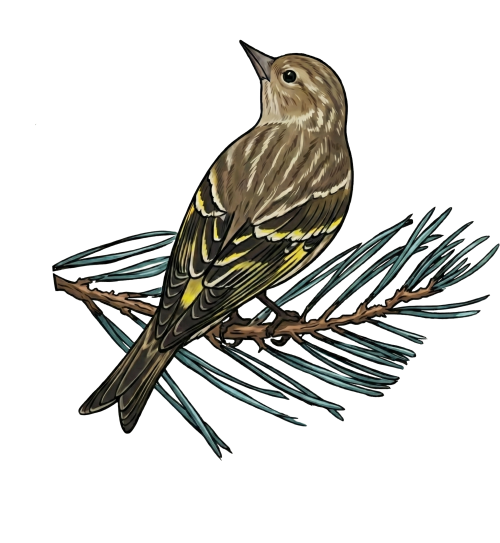
On Saturday morning the group drove to Monterey, VA, by way of McDowell, where a large flock (50) of Pine Siskins were at the feeder stop. After arriving at Monterey, the rest of the day was spent driving to and around the Bluegrass Valley Area. Highlight species were a pair of Wood Ducks at the Trout Hatchery on Rte 220, a mature Golden Eagle at Snowy Mountain and two Red-headed Woodpeckers on Rte 644, along with Black-capped Chickadee and Raven.
+2
On Sunday morning, the group drove south on Rte 220 along the Jackson River to Bolar, where White-breasted Nuthatch and Belted Kingfisher were seen at the bridge stop over the River. At that location, a local land owner told us about a large pond 2 miles south (in Bath County) with a large amount of waterfowl. At this pond, the highlight species seen were groups of Ring-necked Duck, American Wigeon and Gadwall, a Common Merganser and a Hooded Merganser. A Bald Eagle was seen flying over Highland County on the way back to Monterey prior to the end of the trip at noon. — Marv Rubin
+4
Birding in Minnesota
-24 °F, windy, bogs and a few birds would best describe the 2016 Sax-Zim Bog Winter Birding Festival. In February I had the opportunity to attend the 9th annual festival of what is probably the coldest birding festival around. About 9 or 10 years ago Sax-Zim Bog gained notoriety during an invasion of over 450 Great Gray Owls. The festival gets its name from two old towns Sax and Zim located in the bogs about 30 miles northwest of Duluth, Minnesota.
+3
The Great Gray Owl topped my wish list. Unfortunately this year the bird did not cooperate and many people did not get to see one. Friday’s pre-conference trip in the bog was cold and very windy. Once seated in the bus, ice scrapers were handed out as the windows started to freeze and visibility was reduced to zero. The best places to see birds were the various feeder stations. It was fun to see a large number of Common Redpolls and Pine Grosbeaks. One of the best stops was at the visitor center of the Friends of the Sax-Zim Bog, which had lots of feeders and deer carcasses for the birds. I was amazed to see White-breasted and Red-breasted Nuthatches and Downy Woodpeckers eating from the frozen carcasses. A lone Hoary Redpoll was found among the hundreds of Common Redpolls. Another feeder yielded a few Evening Grosbeaks. Along the railroad tracks a few Northern Shrikes were found. Next up were a pair of Black-billed Magpies found along the road chewing down on a dead deer. One stop was a makeshift feeder with peanut butter to attract the elusive Boreal Chickadee; we got two of them and saw several Gray Jays.
+4
Saturday’s Lake country trip was a long drive—300 miles—for only a few birds. Our target birds were Black-backed Woodpecker (not seen) and the Spruce Grouse (seen). A big surprise bird was the American Three-toed Woodpecker. Sunday’s Duluth trip was a lot of fun. Our target bird in the morning was the Bohemian Waxwing. We eventually got great views of a small flock. The afternoon was spent chasing a Gyrfalcon and some gulls, but none were found. The star of the afternoon was undoubtedly “28,” a first year female Snowy Owl. Her camouflage was pretty awesome on a dirty snow pile. For a while we watched her getting comfortable and happily ignoring us. It was a highlight when she yawned. I ended the trip with 35 species, three of them were lifers and one was new for the US. — Gerco Hoogeweg
+4