August 2018

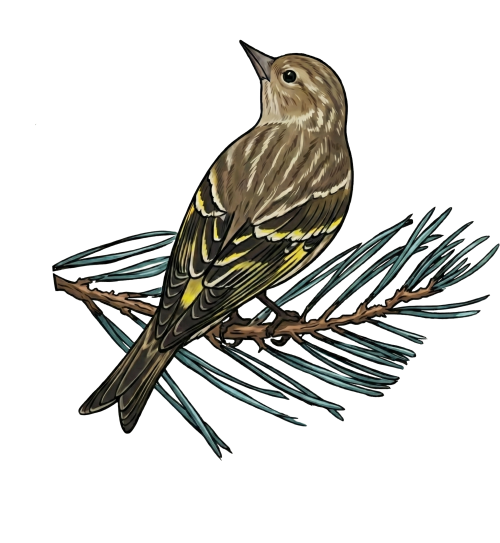
The SISKIN: Newsletter of the Northern Virginia Bird Club
Vol. 63, No. 3 — August 2018
Inside
Calendar of NVBC field trips, August 11-November 7, 2018
New Webmaster
Chincoteague and Highland County Trip Reports
Occoquan Bay Bird Banding 2018
Nemesis
Donations for the Val Kitchens Memorial Educational Grant Program
There was much enthusiasm and affirmation of approval at our last club meeting, when Vice President David Farner announced that the 2018 Val Kitchens Memorial Educational Grant had been awarded to the Community Cloud Forest Conservation in Guatemala to support their “Kids and Birds” program. As reported in the April Siskin, this program focuses on schools within two Important Bird Areas in the cloud forest region of the Guatemalan central highlands. Kids and Birds uses Cornell’s BirdSleuth curriculum to introduce kids to conservation biology, citizen science and ecology through birds. Our grant of $500 funds the costs for a class of sixth graders to participate in the program.
We hope to be able to continue such grants in the future to encourage the preservation or restoration of habitat and the education of young people about birds and their ecology. In light of this, the Board has decided that any donations made to the Club in fiscal year 2018-2019 will be designated for our Educational Grant and Scholarship program. Making an online donation is easy. On the Club website, under the “Join” tab, you will find a button labelled “Donate” to make a contribution via PayPal. Or you can make a contribution by check. Please note on the check if you want to specify it as a donation as opposed to dues. Send to the Club PO address. We hope to continue to provide educational opportunities on both local and broader levels. If you know of a potential candidate for the young birder scholarship or a worthy conservation program of the Americas that should be considered for a grant, please provide that information to David Farner. —Jean Tatalias
+4
NVBC General Meeting — Wednesday, September 19, 8 PM
Birds, Birding and Conservation in Guatemala
Speaker: Robert Cahill
Although less frequently visited by birders than other Central American countries, Guatemala is rich in diversity with over 730 species. Nearly one-third of the country is designated Important Bird Areas. Rob Cahill will introduce us to the birds of Guatemala with a special focus on regional endemic species. Rob will also share information about community-based conservation projects that both help at-risk communities and preserve and restore habitat for birds. His organization, Community Cloud Forest Conservation (CCFC), believes that holistic human and community development through education and capacity-building is the key to conservation and development in Guatemala’s central highlands. CCFC instructs students in grades one through nine in their “Kids and Birds” environmental education program.
+4
Rob Cahill is a founding director of Community Cloud Forest Conservation. Rob and his wife Tara went to Guatemala in 2001 and have specialized in environmental education and agroecology in the Q’eqchi’ Maya context. Rob and his son John Cahill are the eBird editors for the country of Guatemala. The Cahills have led Virginia Society of Ornithology birding trips in Guatemala for the last 3 years.
+3
Early bird refreshments start at 7:30 pm. Any contributions of food or beverage will be most gratefully received. There will be a drawing for door prizes. Northern Virginia Bird Club pins will be available for members who would like to buy them ($5 each).
+1
MEETING PLACE: St. Andrews Episcopal Church, 4000 Lorcom Lane, Arlington, 22207.
Presidential Peentings
Members of the Northern Virginia Bird Club have enjoyed many memorable field trips over the years. Field trips are really at the heart of what we do. We do local trips to places like Huntley Meadows, Long Branch Nature Center, Occoquan Bay National Wildlife Refuge and many others. The club also runs weekend trips to Chincoteague, Highland County, and Cape May.
+3
For the past few years we have also organized what we call “X-trips” which is short for “extreme trips”. These are one day trips where we go to a location a bit more outside our regular range and bird for most of the day. As of now, our X-trips are to the Northern Neck, Bombay Hook, and Shenandoah National Park. The Northern Neck trip is held in the winter if it’s not weathered out. The main focus is waterfowl and we always find a nice variety of ducks on this trip. Bombay Hook is in August and is all about shorebirds migrating through. In June we go to the Limberlost Trail in Shenandoah National Park in search of warblers and other higher altitude breeders. One highlight of X-trips is always the lunch destination. For example, it’s pretty much a requirement that we eat at Sambo’s Tavern in Leipsic for seafood after we bird Bombay Hook. I hope you can join us on one of these trips. Also, if you have any suggestions for future X-trips, we will gladly consider them. —Larry Meade
+4
New Webmaster
NVBC would like to welcome Jeremy Beck as our new webmaster. He will also be joining our board as a director. We would like to thank Ghazali Raheem for his work as our previous webmaster. As always, we welcome new content and photos from our members to be included on our website. The webmaster’s email address has changed to jghyll+nvabc@gmail.com.
Highland County Spring Weekend Trip
Eighteen members visited Highland County, Virginia the weekend of June 1-3, identifying 84 species (with 4 of those being heard only). The trip started Friday, the 1st at 3 pm, at the Highland Inn in Monterey, Virginia with a singing Orchard Oriole seen from the Inn’s back parking area, and proceeded to the Bluegrass Valley area with stops at a Trout Farm and the Forks of Water Road. Highlights were a pair of Baltimore Orioles at the Forks of Water and Bobolinks, Ravens, Eastern Meadowlarks, three species of swallows (Barn, Bank and Cliff) and a Pileated Woodpecker along the Bluegrass Valley Roads.
The next morning following breakfast the group went to Paddy’s Knob where the constant rain contributed to a lack of seeing or hearing a Mourning Warbler and made views of all the birds difficult. However, a Scarlet Tanager, Black-and-White, Yellow and Chestnut-sided Warblers and American Redstarts were seen. In the afternoon we returned to Bluegrass Valley where a Red-headed Woodpecker, Willow Flycatcher and Yellow Warbler were among the species seen. No Golden-winged Warblers were seen or heard during our stop at the usual spot on Wilmer Mountain Road. However, on Sunday morning, the 3rd, instead of returning to the Bluegrass Valley, we drove south to the Bolar area and found a wet and preening Golden-winged Warbler on Big Valley Road that most participants saw, with several getting a scope view. Other highlights in the Bolar area were sightings of Cedar Waxwings, Baltimore and Orchard Orioles, a Yellow-billed Cuckoo and Brown Thrashers at the Jackson River Bridge, and Field Sparrows and two soaring, immature, Red-Tailed and Red-shouldered Hawks along Big Valley Road. —Mary Rubin
Spring Weekend Trip: Chincoteague
Members of the Northern Virginia Bird Club went on our annual spring trip to Chincoteague on the weekend of May 18 to 20. Despite the forecasts for rain over the weekend, the weather turned out to be better than expected, helping us collectively find 102 species over the weekend. Friday afternoon started with high winds making for a slow start to our birding weekend. The drive around the Wildlife Loop at the Chincoteague National Wildlife Refuge was not very productive, but we did manage to find Cattle Egrets dressed in their apricot breeding colors, a flyover Glossy Ibis and a Least Sandpiper amongst the Semipalmated and Spotted Sandpipers. We followed that up with a drive out Beach Road to the north beach parking lot where we observed a pair of Piping Plovers hunkered down in a protective cage trying to stay out of the winds. Our evening trip to find the Chuck-will’s-widow at sunset on Friday night was very successful. We heard a couple of “Chucks” around the Wildlife Loop parking lot and managed to see the bird fly around and briefly land on a log.
Saturday delivered a fine day of birding while back home Northern Virginia got hammered with thunderstorms. We started birding by walking to the boardwalk near the hotel, where we had excellent views of Clapper Rails and Nelson’s Sparrows in the marsh, and a Least Sandpiper in the short grass next to the road. A very lucky flyover of a flock of Brant was a nice addition. Our trip out to Tom’s Cove and the beach parking lots netted us the usual cast of finds – Piping Plovers, Least Terns, Royal Terns, Black Skimmers and hundreds each of Semipalmated Sandpipers, Dunlins, and Semipalmated Plovers. Our best finds were a single Western Sandpiper, Whimbrels, a flock of Red Knots, and a couple of Marbled Godwits. In the afternoon, we started at the Chincoteague Island Nature Trail and found a good selection of migrants: Blackpoll, Black-throated Green and Magnolia Warblers plus a female Scarlet Tanager. Queen Sound Flats produced the usual breeding colonies of Black-necked Stilts and Common Terns.
Sunday morning brought us even better weather for our boat trip out on Chincoteague Inlet provided to us by Daisey’s Island Cruises. Highlights of the trip were a dozen Red Knots — several of which were in breeding plumage, another flock of White Ibis, and up-close looks at Whimbrels feeding on the exposed mud flats. —Elton Morel
+3
How Plants Support Wildlife — September 12
Plants support tremendous biodiversity and complex food webs, including food for insect-eating birds and other wildlife. On September 12, entomologist Dr. Desiree Narango will share her research comparing how well native and nonnative trees provide food for the Carolina Chickadee, other insectivorous birds and other wildlife. This free, public program is sponsored by the Friends of Dyke Marsh, the Northern Virginia Bird Club, Plant NoVa Natives and the Virginia Native Plant Society, Potowmack Chapter. It will be at 7:30 pm, Huntley Meadows Park Visitor Center, 3701 Lockheed Boulevard, Alexandria, VA 22306.
+4
Occoquan Bay National Wildlife Refuge Bird Banding 2018
The banding program at the Occoquan Bay spring migration station was surprisingly successful despite the weather. We lost a lot of banding time due to rain and wind but managed to band 703 birds. This was our fifth best year since opening in 2001. The number of species banded this year totaled 57. We added two new species to our list of birds banded: Least Flycatcher and Yellow-throated Warbler for an overall station total of 102 species.
+4
This year we banded a record-breaking 158 Yellow-rumped (Myrtle) Warblers, after a complete dearth of this species for the past nine years. The second most common bird was the Common Yellowthroat at 130, then 79 Gray Catbirds but only 54 White-throated Sparrows. A Ruby-crowned Kinglet has the distinction of being the 9,000th bird banded at the station. We did very well on recaptures including the amazing recapture of a male Common Yellowthroat which I banded on May 18, 2007 as a second year bird. This makes him officially 11 years and 10 months old which will probably set a new longevity record for this species! Our banding season starts the last week of March and runs till Memorial Day. We are open to visitors Wednesdays, Fridays, Saturdays and Sundays from 7:00 am till 11:00 am weather permitting. —Joanna Taylor
+4
Nemesis
If you have been birding for a while, you might have a nemesis bird. For me, my nemesis has been the Connecticut Warbler. I have chased them many times over the years, sometimes missing the bird by a day and sometimes by minutes. In the East, they only migrate through for a couple of weeks in the fall, so there is only a small window of time in which you can see them. I recently realized that the only way to slay this nemesis was to seek it in its lair—the bogs of Minnesota.
+4
On the first day of my quest, my trusty guide, John Richardson, and I set out from Duluth for the Sax-Zim Bog. We did manage to hear our target bird singing on Wolf Avenue, but it was on private land. On day two, we went back to Wolfe Road. The bird was singing again and was closer than ever! A bit more audial enticement brought the Connecticut Warbler closer and closer. Suddenly a yellow streak blasted across the road. Much to my surprise and delight, it decided to fly in and perch out in the open at eye level no more than thirty feet away from me. I clearly saw the gray hood and especially the prominent eye-ring. My nemesis was conquered! This was the defining moment of my trip and the end of a decade long quest. —Larry Meade
+4
Club Information & Contacts
Join the Northern Virginia Bird Club: Dues for 2018 are $10 for Individual and $15 for Family Membership. Checks should be sent to: NVBC, Attn: Membership, P.O. Box 5812, Arlington, VA 22205-0812.
+1
President: Larry Meade, 703-206-9030
VP, Programs: David Farner, 443-643-6141
VP, Field Activities: Elton Morel, 703-907-9951
Secretary: Diane Marton, 703-527-7360
Treasurer: Jean Tatalias, 703-281-6099
Next General Meeting Dates: September 19 and November 28, 2018.
Next Board Meeting: Tuesday, September 11, 2018, 7:30 pm at Diane Marton’s home.
Deadline for next Siskin: October 1, 2018.