February 2014

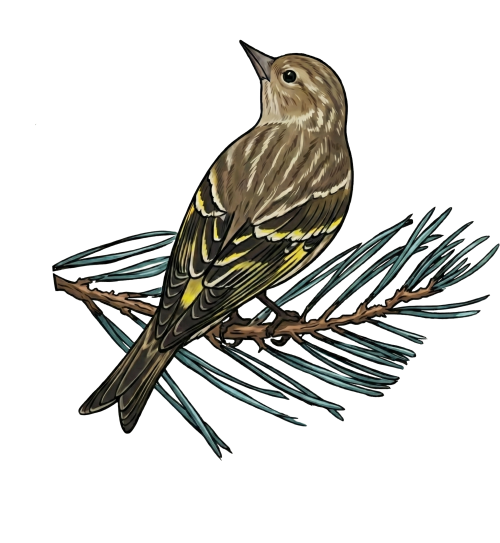
THE SISKIN
Newsletter of the Northern Virginia Bird Club
Vol. 59, No. 1
February 2014
Inside
Calendar of NVBC trips and events, February 12-May 10, 2014
Cape May 2013-report and photos from NVBC’s fall weekend trip
2014 Great Dismal Swamp Birding Festival/VSO Annual Meeting
Report on the Seneca MD/VA Christmas Bird Count
HIGHLAND COUNTY WINTER WEEKEND
The Winter Highland weekend club trip is scheduled for February 28 to March 2 (Friday to Sunday). Late winter is an excellent time to visit Highland County, especially for its wintering Golden Eagles, Rough-legged Hawks, winter finches and wonderful winter scenery. On last year’s trip, we saw a total of 52 species. Highlight sightings besides the previously mentioned raptors included Eastern Screech Owl, Northern Harrier, Black-capped Chickadee, Purple Finch, Pine Siskin and American Tree Sparrow.
Plans for the weekend include birding the Augusta area Friday afternoon starting at 1 PM (optional) with an overnight stay at the Staunton Best Western. On Saturday morning we will drive to and bird northern Highland County with an overnight stay in Monterey at the Highland Inn. After birding southern Highland County Sunday morning, the trip will conclude at noon.
NVBC membership is required for this trip. To sign up, call or email Elton Morel at 703-553-4860 or eltonlmorel@verizon.net. The trip is limited to 16 people and usually fills up, so please contact Elton first to ensure that space is available and for information to place hotel reservations. If the trip is full, your name can be put on a waiting list. — Elton Morel
NVBC GENERAL MEETING—WEDNESDAY, FEBRUARY 19, 8 PM
Singing and Dancing through Ecuador and the Galapagos
Speaker BILL YOUNG
William Young is a birder and author from Arlington, Virginia. His presentation, based on a 2013 trip to Ecuador and the Galapagos, will include video footage, photographs, and audio recordings. Bill has traveled extensively throughout the United States and the world to study birds, and he is especially interested in bird behavior and bird conservation.
His book The Fascination of Birds: From the Albatross to the Yellowthroat will be released by Dover Publications this spring. Written for both experienced birders and novices, the book looks at the connections between birds and a broad variety of subject areas, including biology, ecology, literature, music, history, politics, economics, religion, geography, physics, chemistry, linguistics, the visual arts, the performing arts, sports, and comedy.
Early bird refreshments start at 7:30 PM. There will be a drawing for door prizes. (If you have any bird-related items you would like to contribute as door prizes, please bring them along.) Northern Virginia Bird Club pins will be available for members who would like to buy them ($5 each).
MEETING PLACE: Church of the Covenant, 2666 Military Road, Arlington, 22207.
Presidential Peentings
The big birding news this winter has been the invasion of Snowy Owls into our area. These amazing visitors venture south every year to escape the frozen Arctic conditions and to find easier access to prey. This year, however, the numbers of Snowy Owls this far south are phenomenal. They have been scattered along the East Coast as far south as Hatteras and have also been spotted at various locations inland. One has been hanging out on the Chesapeake Bay Bridge for several weeks. Every airport in the area seems to have had a Snowy Owl visit at one time or another this winter. These birds are used to hunting on tundra so the open spaces at airports provide an ideal habitat for them.
Unfortunately these owls are low flying heavy birds and can pose a danger to airplanes taking off or landing. Until public outcry put a stop to the practice, officials in New York were actually shooting the owls. Now the birds are being captured and released instead. Contrary to popular belief, most of these Snowy Owls are not starving when they come south and the majority make it back north when the weather gets warmer. I hope that you have been able to get out and see at least one of these magnificent birds this season.
You can check VA Bird or eBird to find the latest sightings. You do not need to have an account with eBird to search their database. Just go to www.ebird.org and click on “Explore Data” then click on “Range and Point Maps”. Type in species name (Snowy Owl), then set the date range (current year) and location (Virginia). All of the recent sightings of Snowy Owls (or at least those reported to eBird) will pop up along with checklists and maps. Happy chasing! — Larry Meade
Great Dismal Swamp Birding Festival/VSO Annual Meeting
The 2014 Great Dismal Swamp Birding Festival will be Thursday, April 24, through Saturday, April 26. The festival is an annual event at Great Dismal Swamp National Wildlife Refuge, located on the border of Virginia and North Carolina near Chesapeake, VA. The refuge is one of the premier birding locations on the east coast and is known particularly as a place to see the Swainson’s Warbler and Wayne’s Warbler (a subspecies of the Black-throated Green Warbler). Festival events will include guided walks, bus tours, canoe trips, nature photography workshops, owl prowls, and visits to the refuge’s banding station. All are free of charge; however, most require reservations, which can be made by calling the Refuge Headquarters at (757) 986-3705.
In conjunction with the festival, the Virginia Society of Ornithology will be holding its 2014 annual meeting in Chesapeake on April 24-27. Meeting events include a Saturday night banquet with a keynote speech by Alicia King, the Communication Coordinator and Urban Bird Treaty Program Coordinator for the U.S. Fish and Wildlife Service Migratory Bird Program.
Report on the Seneca, MD/VA, Christmas Bird Count, December 15, 2013
The Seneca count circle is about 40 percent in Fairfax and Loudoun counties and 60 percent in Montgomery County, Maryland. Count day started cloudy and foggy, with sun and wind later, temperatures 30s to mid-40s. Our 100 counters (including 22 in Virginia) found 101 species with two additional count week species. This 103 is the highest count since 105 in 2004, and well above 2012’s 98 and the 96.7 previous ten-year average. We tallied 32,095 individual birds (including 9,591 in our Virginia sectors), our highest since 2007. Reports of Snowy Owl, Snow Bunting, and Lapland Longspur tantalizingly close to our circle before count day had us salivating, but none of them ventured into our circle.
CAPE MAY 2013
Fall bird watching in Cape May is extremely dependent on the weather and especially the wind. Our 2013 fall trip was characterized by winds coming from many different directions and occasionally the correct one. Friday we started our trip with a visit to Cox Hall Wildlife Management Area at the Villa’s. This area was a golf course that is being transformed from golf greens to forested areas. Our exploration resulted in stellar looks of a Bald Eagle perched in a tree, many Eastern Bluebirds, countless Yellow-rumped Warblers, and a nice assortment of raptors, including Sharp-shinned Hawk, Coopers Hawk, and Merlin. A Black-throated Green Warbler was probably our best bird during the walk.
The traditional Saturday morning walk at the Beach Pavilion featured a group of 400-plus skimmers showing off their aerial acrobatics. We also saw Black Scoters, Northern Gannets, and a Peregrine Falcon. Our next stop was Hereford Lighthouse and Garden followed by a beach walk along the Inlet. The beach was the real show, with countless Black and Surf Scoters, several Wood Ducks, and Green-winged Teal flying by. Along the surf we found Black-bellied Plovers, Sanderlings, and a few Red Knots.
Stony Point Harbor beach was a great spot to bird for a while, full of Sanderlings, Black-bellied Plovers, Semipalmated Plover and Semipalmated Sandpiper. At long last we did see three White-winged Scoters in a group. The afternoon was spent in a slightly wet Cape May State Park. A walk through the marshes and the forests produced a wide variety of birds including many Brown Creepers, Kinglets, and Phoebes. The highlight was a Clay-colored Sparrow seen in the open near the brush pile. We ended the day with a walk in The Meadows, where a Glossy Ibis was by far the best bird we found. Thinking that we had a so-so day with the shifting wind and rain, we still tallied 99 species on Saturday.
Morning flight on Sunday was very weak, and we instead explored Higbee Beach Wildlife Management Area. — Gerco Hoogeweg
Remember…
…to pay your 2014 dues if you haven’t already. The mailing label on your copy of The Siskin shows the year through which your dues are current. Thanks!