February 2015
The SISKIN
Newsletter of the Northern Virginia Bird Club
Vol. 60, No. 1
February 2015
Inside
Calendar of NVBC field trips February 8 – May 10, 2015
Great Backyard Bird Count
Chincoteague Trip Report
Winter Pelagic Trip
Bluebirds in Winter
Book Notes
Winter Highland Trip
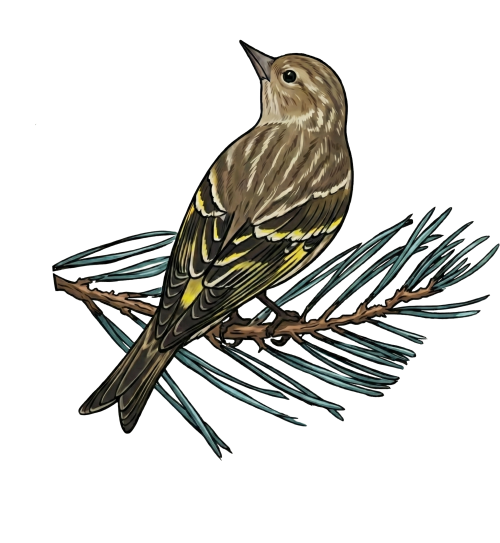
Our winter trip to Highland County will be held on the weekend of February 27 to March 1 (Friday to Sunday). Late winter is an excellent time to visit Highland County, especially for its wintering Golden Eagles, Rough-legged Hawks, winter finches and wonderful winter scenery. On last year’s trip, we saw a total of 62 species. Highlight sightings in the Augusta and Staunton area were a Snow Goose, Red-necked Grebe, White-winged Scoter, Northern Harrier and Clay-colored Sparrow. In Highland County, we found Golden Eagle, Eastern Screech Owl, Black-capped Chickadees, Horned Lark and American Tree Sparrow. While we missed Rough-legged Hawk and the winter finches because they were very scarce last winter, this winter is already very good for Pine Siskins and Purple Finches and we will make a concerted effort to find Rough-legged Hawks.
Plans for the weekend include birding the Augusta area Friday afternoon starting at 1:00 pm (optional) with an overnight stay at the Staunton Best Western. On Saturday morning we will drive to and bird northern Highland County with an overnight stay in Monterey. Unfortunately, the charming Highland Inn has closed and is up for sale. Instead, we will be staying at the Montvallee Motel. After birding southern Highland County Sunday morning, the trip will conclude at noon.
NVBC membership is required for this trip. To sign up for this trip, call or email Elton Morel (703-553-4860 or eltonlmorel@verizon.net). The trip is limited to 16 people and usually fills up, so please contact Elton Morel first to ensure that space is available and for information to place hotel reservations. If the trip is full, your name can be put on a waiting list.
— Elton Morel
NVBC GENERAL MEETING — WEDNESDAY, FEBRUARY 18, 8 PM
The New Breeding Bird Atlas of Virginia
Speaker: Dr. Ashley Peele
In 2016, the Virginia Society of Ornithology (VSO) will partner with the Virginia Department of Game and Inland Fisheries (DGIF) to begin the Commonwealth’s second Breeding Bird Atlas (BBA). The goal of a BBA is to map the distribution and relative abundance of all bird species breeding within a given area. Comparing data from Virginia’s first BBA (1984-1989) with data from the upcoming project will provide a clearer picture of how Virginia’s bird populations have changed over the last 25 years. This information is critical for conservation and management of our bird species. Dr. Peele will talk about the importance of Breeding Bird Atlases and how the birding community can participate in the project.
Dr. Ashley Peele received her Ph.D. in Ecology and Evolutionary Biology from Tulane University in 2014. Her dissertation research focused on the effects of habitat quality and wintering grounds on the health and survival of Neotropical migratory songbirds. Prior to her time at Tulane, she was involved in several avian research and conservation projects in various parts of the world. Dr. Peele is currently the BBA Coordinator at the Conservation Management Institute at Virginia Tech.
Early bird refreshments start at 7:30 pm. Any contributions of food or beverage will be most gratefully received. There will be a drawing for door prizes. Northern Virginia Bird Club pins will be available for members who would like to buy them ($5 each).
MEETING PLACE: St. Andrews Episcopal Church, 4000 Lorcom Lane, Arlington, 22207.
Presidential Peentings
In spite of the cold and snow that we have experienced lately, there are signs that spring is not too far away. Resident birds such as Northern Cardinals and Carolina Wrens are beginning to sing. On a recent walk at Huntley Meadows Park, a couple of my birding friends and I observed an American Woodcock (the “Peent” of Presidential Peentings) doing its sky dance. It was amazing to hear the twittering of the bird’s wings as it spiraled up into the darkening sky and then its chirping as it dove back toward the ground. For many of us, the return of the Woodcocks is the first real indicator of the return of spring.
Soon the Woodcocks will be joined by Ospreys and Blue-gray Gnatcatchers and then finally the warblers and other Neotropical migrants will make their appearance. In the meantime, there is still plenty of good winter birding to be had. Snowy Owls have once again made an appearance in our region and wintering ducks and geese are still around in good numbers. No matter the season, it’s always a good time to get out and look at birds!
— Larry Meade
Great Backyard Bird Count: February 13-16, 2015
The Great Backyard Bird Count is an annual four-day event that engages bird watchers of all ages in counting birds to create a real-time snapshot of where the birds are. GBBC is a joint project of the Cornell Lab of Ornithology and the National Audubon Society with Bird Studies Canada and many international partners. It’s easy and fun! For more information on how to participate, go to birdcount.org.
Chincoteague Winter Trip Report
Twenty-three members of the Northern Virginia Bird Club visited the Chincoteague National Wildlife Refuge and the Chesapeake Bay Bridge and Tunnel (CBBT) Complex on the weekend of January 9-11. The trip was led by Marc Ribaudo and me. We collectively tallied 95 species for the trip.
Friday afternoon was bitterly cold and windy. The group drove around Snow Goose Pond noting many Tundra Swans and dabbling ducks. The highlight was a lone Ross’s Goose found by Marc earlier that morning. We also found a few American Bitterns hunkered down in the marsh near Mariner’s Point. On Saturday, after a brief and unsuccessful search for Clapper Rails at the boardwalk, we drove to the end of Beach Road and walked toward the mudflats. We were treated to many Red Knots and Dunlins feeding on the flats. We also found several Horned Larks and a few Savannah Sparrows along the dunes.
Sunday’s visit to the CBBT was very successful. On Island #4, we found all three scoter species, Long-tailed Ducks, Great Cormorants and Northern Gannets. We also found several Purple Sandpipers on the rocks. On Island #3, we found several Common Eiders and a lone female Harlequin Duck. On Island #2, we were treated to a Razorbill floating fairly close to the island. We also found several Lesser Black-backed Gulls amongst the many Herring and Great Black-backed Gulls.
— Elton Morel
Winter Pelagic Trip
On January 17, a few club members joined a pelagic trip out of Virginia Beach led by Brian Patteson. The weather was cooperative, and the group was treated to some excellent sightings. The highlights were several Atlantic Puffins and Razorbills seen both in flight and on the water. We also saw many Northern Gannets, Black-legged Kittiwakes, and a few jaegers. The trip provided a great opportunity to see these pelagic species that are rarely seen from shore.
— Gerco Hoogeweg
Bluebirds in Winter
While many of our breeding birds migrate south for the winter, Eastern Bluebirds are year-round residents in Northern Virginia. During the winter months, bluebirds often form small flocks and roam the area in search of food. While they primarily eat insects during the summer, their winter diet consists largely of berries from plants such as Eastern Red Cedar, American Holly and Poison Ivy.
One of the most interesting behaviors of bluebirds in winter is their communal roosting. On particularly cold nights, several bluebirds may huddle together in a nest box or tree cavity to share body heat. This behavior helps them survive the frigid temperatures. Providing a clean nest box in your yard can give bluebirds a safe place to roost during the winter and a head start on the breeding season in the spring.
— Larry Meade
Book Notes
Two recent books offer different perspectives on the world of birds. The Thing with Feathers: The Surprising Lives of Birds and What They Reveal About Being Human by Noah Strycker (2014) explores the intelligence and social behavior of birds and draws interesting parallels to human behavior. Strycker’s engaging writing style makes this a must-read for anyone interested in bird behavior.
For those interested in the history of birding and conservation, Ten Thousand Birds: Ornithology since Darwin by Tim Birkhead, Jo Wimpenny, and Bob Montgomerie (2014) provides a comprehensive look at how our understanding of birds has evolved over the past 150 years. The book is beautifully illustrated and filled with fascinating stories about the people and discoveries that have shaped modern ornithology.
— Carol and Chris White
Club Announcements
NVBC eMail Exchange: To receive email notices about upcoming trips and club news, join the NVBC eMail Exchange. Send an email to nvbc-exchange-subscribe@googlegroups.com.
Membership Renewals: A reminder to pay your 2015 dues if you haven’t already. Check your mailing label for your status.
Volunteers: The club is always looking for volunteers to help with various activities. If you are interested in leading a walk or helping with the newsletter, please contact a board member.