February 2016

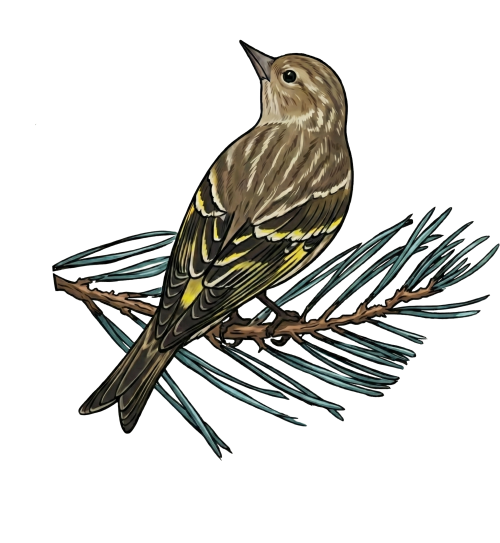
The SISKIN
Newsletter of the Northern Virginia Bird Club
Vol. 61, No. 1
February 2016
Inside
Calendar of NVBC field trips, February 7- May 7, 2016
Christmas Bird Count Adventures
Great Backyard Bird Count
How Does Noise Affect Birds’ Communication Presentation
Youth Birding Scholarship Deadline
Book Notes
Report on Virginia Beach Pelagic Trip
Winter Highland County Trip
Our winter trip to Highland County will be held on the weekend of March 4 to 6 (Friday to Sunday). The trip will be led this year by Marv Rubin. Late winter is an excellent time to visit Highland County, especially for its wintering Golden Eagles, Rough-legged Hawks, winter finches and wonderful winter scenery. On last year’s trip, we saw a total of 57 species. Highlight sightings in the Augusta and Rockingham counties and around Staunton, were Trumpeter Swans, Horned Larks, American Pipits, Eastern Screech-Owls and the amazing occurrence of a Smith’s Longspur at the Shenandoah Valley Regional Airport. In Highland County, we found Golden Eagles, Black-capped Chickadees, Purple Finches and Pine Siskins. Unfortunately, we missed Rough-legged Hawks as we had to leave Highland County early Sunday morning because of an impending snow storm. This year we will make a determined effort to find Rough-legged Hawks.
Plans for the weekend include birding in Augusta County Friday afternoon starting at 1:00 pm (optional). We will spend the night at the Staunton Best Western. On Saturday morning we will drive to and bird northern Highland County. We will spend Saturday night at the re-opened Highland Inn in Monterey. After birding southern Highland County Sunday morning, the trip will conclude at noon. NVBC membership is required for this trip. To sign up for this trip, call or email Elton Morel (703-553-4860 or eltonlmorel@verizon.net). The trip is limited to 16 people and usually fills up, so please contact Elton Morel first to ensure that space is available and for information to place hotel reservations. If the trip is full, your name can be put on a waiting list.
— Elton Morel
NVBC GENERAL MEETING—WEDNESDAY, FEBRUARY 17, 8 PM
Birding in Cuba
Speaker Dixie Sommers
Cuba hosts a diverse range of birds, including the world’s smallest bird – the Bee Hummingbird – and about two dozen endemics. Join the Northern Virginia Bird Club meeting for Dixie Sommers’ presentation on her February 2015 birding visit to Cuba. She spent two weeks on the island, traveling about two-thirds of the island’s 777 mile length to see the tiny hummingbird as well as the Cuban Trogan, Cuban Emerald, Cuban Tody, Giant Kingbird, Stygian Owl, and 150 more species. The trip was with the Caribbean Conservation Trust, which has been conducting birding trips in Cuba for about 20 years. In addition to sharing her photographs of birds, Dixie will give you a taste of Cuban sights and how Cubans live today. Yes, there are lots of old cars! But there is lots more, including vibrant street life in Havana, beautiful beaches, historic old towns, and struggling rural areas.
Dixie Sommers became a serious birder after moving back to the Washington area from Ohio in 2006, adding to her long interest in nature photography and travel. She is a regular eBird user and enjoys using photography to help learn about the birds, and sharing her photos. In addition to favorite places in Virginia, her recent birding travels include Alaska, Cuba, Ecuador, Ohio, South Florida, the Rio Grande Valley, Antarctica, and Argentina. Dixie is a member of the Northern Virginia Bird Club and serves on the board of the Audubon Society of Northern Virginia. After a long career of counting jobs and workers for the US Bureau of Labor Statistics, she is retired and now counts birds!
Early bird refreshments start at 7:30 pm. Any contributions of food or beverage will be most gratefully received. There will be a drawing for door prizes. Northern Virginia Bird Club pins will be available for members who would like to buy them ($5 each).
MEETING PLACE: St. Andrews Episcopal Church, 4000 Lorcom Lane, Arlington, 22207.
Presidential Peentings
This winter has been a bit of a strange one. The record warmth has made birding conditions more pleasant. It has been nice to get outside without having to worry about facing bone-chilling cold. During one Christmas Bird Count morning we were serenaded by at least three species of frogs that had been woken up from their winter torpor by warm temperatures. The balmy weather has also had an effect on bird sightings. Waterfowl have been notably low in terms of both numbers and diversity. It has just not been cold enough yet in the north to force south significant flocks seeking to escape frozen ponds and lakes. Cold water loving birds such as Atlantic Puffins have not been seen offshore during recent pelagic trips out of Virginia Beach. Other birds normally found more south of us in the winter seem to have lingered. For example, there have been more reports of Gray Catbirds and Brown Thrashers on Christmas Bird Counts than usual. A flock of over 5,000 American Robins that I observed flying overhead in Loudoun County also seemed unusual. Weather and climate matter and it’s interesting to see their effect on birds and other wildlife.
— Larry Meade
Christmas Bird Count Adventures
This year I decided to go “all in” on Christmas Bird Counts, so I agreed to bird in five different circles on five different days. The various counts were all enjoyable, educational and well worth the necessary time and effort. I especially appreciate the efforts of the many birders who joined me on my CBC teams. No matter what their experience levels, they all contributed to what turned out to be a fun and productive two weeks of winter birding. I will not give an overly detailed description of each of my CBC birding experiences, but I will discuss some highlights and general trends that I noticed.
I kicked off the season with the DC count. My sector of this CBC circle is all in Virginia and my team birded Dyke Marsh and sections of the Mount Vernon Trail. One of the first birds I recorded was a Great-horned Owl that could be heard hooting in the distance just before dawn. The dearth of waterfowl has been a theme this winter and we only saw a few species of ducks. However, there were Bald Eagles and Red-shouldered Hawks in the area. Winter Wrens entertained us with their antics and Yellow-rumped Warblers were out in full force.
The next day I drove out to Haymarket to participate in The Plains count. I was joined by a new team of birders at Silver Lake. We found all seven woodpeckers normally seen in the region. Red-headed Woodpeckers have been reliable at Silver Lake for several months now. We also found a Purple Finch and a Gray Catbird. Later we birded the North Fork Wetland which is also known as Camp Snyder. We completed our sweep of normally occurring sparrow species by tallying White-crowned, American Tree, and Chipping Sparrows. A highlight was a group of seven Common Ravens flying together over the wetland. Two of the pairs were flying in tandem.
My next adventure was a week later at the Nokesville count in Prince William County. My team on this day birded the Foggy Bottom Wetland which is behind a farm property. A pair of Snow Geese flying over provided an early surprise. Soon after this, we observed thousands of Ring-billed Gulls streaming over. A Northern Harrier and Hooded Mergansers also were nice sightings. We also had an interesting wildlife encounter that did not involve birds. A very angry raccoon was in full battle mode as it attempted to remove another animal from a choice hollow tree. The screaming could be heard from quite a distance away. After lunch at Merrimac Farm, some of us headed over to the Prince William County landfill to look for unusual gulls. The presence of dozens of Laughing Gulls was the only thing really notable here.
Two days later it was time for the Central Loudoun CBC. My team covered the Dulles Wetlands, Oatlands and the Little River Farm. We found many blackbirds and robins. We also saw all seven woodpeckers, a Palm Warbler, Bald Eagles, a Brown Thrasher and Fox Sparrows. The bird of the day had to be a juvenile Black-crowned Night-Heron at Little River Farm. This was only the second sighting of this bird in the history of the Central Loudoun count.
My last count was the Fort Belvoir CBC where I birded Pohick Bay Park. Here we found a Red-headed Woodpecker, many Great Blue Herons and Pied-billed Grebes and a Horned Grebe. Bald Eagles were flying around and a few ducks were swimming around in the bay. The bird of the day was one of the last birds I saw. I briefly saw a shorebird fly into a small beach along the shoreline of the bay. Unfortunately, I was above the bird and fairly far away with an obstructed view. I saw it walk a bit and give a definite bob before it disappeared. Based on my views of the bird in flight, its behavior and its size, I am confident that it was a Solitary Sandpiper, which would be a new bird for the count if approved.
I noticed a few trends after doing these counts. Most of the usual winter birds seem to be present in our area, though some seem to be either more numerous or less numerous than usual. The paucity of waterfowl is something that stands out the most. The warm weather is almost certainly the main reason that ducks have not arrived in our region in their usual numbers. I have also noticed the expanded numbers of Red-headed Woodpeckers around our area. The generous acorn crop has likely kept these birds well fed and more willing to stick around. I enjoyed every minute of my Christmas Bird Count even when the going occasionally got a bit arduous. I was able to bird with old friends and make some new ones. I saw many different species of birds in a variety of habitats. I also appreciate that I was able to contribute as a citizen scientist to the longest running bird study that there is.
— Larry Meade
Great Backyard Bird Count: February 12-15, 2016
Wind or weather keeping you close to home? Having fun watching the feeders with the kids or grandkids? Why not join the Great Backyard Bird Count on February 12-15! Maybe you can fledge a new birder in the family. The GBBC is led by the Cornell Lab of Ornithology and National Audubon Society, with Bird Studies Canada and many international partners. Register and learn how to submit your sightings online.
— Jean Tatalias
How Does Noise Affect Birds’ Communication?
Join the Friends of Dyke Marsh (FODM) on Sunday, February 28, at 2 pm at Sherwood Regional Library to hear a presentation by Dr. David Luther on the effects of noise, both from animals and human causes, on birds’ communication. Dr. Luther, a biology professor at George Mason University, researches animal behavior with an emphasis on animal communication. A major focus of his research is on the influence of background noise on avian behavior and evolution. Dr. Luther has conducted studies in the Washington, DC areas, including Rock Creek Park and Fairfax County. His talk will cover some bird species commonly seen at Dyke Marsh.
This program is sponsored by the Friends of Dyke Marsh, the Virginia Society of Ornithology, the Audubon Society of Northern Virginia, the Raptor Conservancy of Virginia, the Audubon Society of the District of Columbia, and the Northern Virginia Bird Club. The meeting will be held at Sherwood Regional Library, 2501 Sherwood Hall Lane, Alexandria 22306. In case of heavy snow or other inclement weather, please check the Fairfax County library calendar, the FODM website and the FODM Facebook page.
Virginia Beach Pelagic Trip
On Saturday, December 5, I went on a pelagic trip out of Virginia Beach on Brian Patteson’s Stormy Petrel II. I have been on many pelagic trips in the past, especially in California, but this was my first pelagic trip from Virginia waters with the expectation to fill a few glaring holes in my Virginia State List. I was not disappointed. A pelagic trip from Virginia Beach is a long trip – many miles to travel to get to the continental shelf where there are the more interesting birds. We lucked out with decent weather with 3 to 4 foot swells but the wind was so strong that I spent the majority of the trip in the back of the boat on the side sheltered from the wind and salt spray.
Our highlights started with many Northern Gannets in the inshore waters followed by thousands of Bonaparte’s Gulls in multiple, swirling feeding flocks. Constant chumming off the back of the boat kept the gulls nearby and eventually brought in our first pelagic species: beautiful Black-legged Kittiwakes. We also saw a distant jaeger that attacked a Herring Gull – the ID of this jaeger was uncertain, either a Parasitic or a Pomarine.
Book Notes
Bernd Heinrich’s forthcoming, One Wild Bird At a Time: Portraits of Individual Lives, is another winner. This time his theme is how puzzling over the idiosyncratic behavior of birds who visit his Maine cabin, has led him to major discoveries. Among them how male woodpeckers will vigorously peck on a tree to woo a prospective mate. He infers that the bird is advertising his nest-building skills. He also observes vireos nesting near his cabin that allowed him to observe how they deliberately reduced the number of eggs they hatched, after an unseasonal freeze, to accommodate a reduced food supply. Especially interesting is his notes on the function of chickadees in leading other birds to food sources. Sharply observed and enhanced by many appealing anecdotes.
— Carol and Chris White
Winter wind and weather keeping you homebound? Undoubtedly you’re dreaming of spring migration, perhaps a trip to the Delaware Bay shores when horseshoe crabs spawn and their eggs attract the rufa Red Knot subspecies. Then pick up Moonbird: A Year On The Wind With The Great Survivor B95 (c 2012) by award-winning author Phillip Hoose.
Club Announcements
Volunteers Needed for Website Redesign: The Club needs volunteers to help redesign our website on a more current software platform for easier maintenance in the future. If you want to help on the redesign team or can contribute by being a future maintainer, please volunteer. The website is vital to our member communications! Tutoring in use of the software (most likely WordPress) can be included. Contact Len Alfredson or Jean Tatalias.
Youth Birding Scholarship Opportunity: Deadline: March 13, 2016. Don’t forget about the Val Kitchens Memorial Young Birder Scholarship. The Club is seeking applicants from 13 to 17 years of age who want support of up to $500 to attend a birding activity.
Reminder: Pay your 2016 dues. If not paid, this will be the last issue you receive.