November 2014

The SISKIN
Newsletter of the Northern Virginia Bird Club
Vol. 59, No. 4
November 2014
Inside
Calendar of NVBC field trips, November-12, 2014 – February 8, 2015
Michigan Birding
Highland County winter trip
2015 ASNV Winter Waterfowl Survey
Upcoming Christmas Bird Counts in Northern Virginia
eBirders: Practice and Changes
2014 Treasurer’s Report
Book Notes
Report from Camp Colorado
Insert – 2015 membership renewal notice
Winter Chincoteague Trip
The Winter Chincoteague club trip is scheduled for February 6-8 (Friday to Sunday) co-led by Marc Ribaudo and me. February is an excellent time to visit Chincoteague National Wildlife Refuge (NWR) and the Chesapeake Bay Bridge-Tunnel Islands (CBBT). The Refuge is loaded with wintering waterfowl and shorebirds while the CBBT is famous for sea ducks. On last year’s trip, we saw a total of 98 species including 22 species of waterfowl and 11 species of shorebirds. Highlight sightings were Red-necked Grebes at several locations in what turned out to be a remarkable invasion year for this species, many Long-tailed Ducks and all three scoter species at the CBBT Islands.
Plans for the weekend include birding the Chincoteague area Friday afternoon starting at 3:15 pm (optional) and Saturday starting at 7:30 am. Activities on Friday and Saturday include birding along Beach Road, Swan Cove and Tom’s Cove and around the Wildlife Loop. Time and tides permitting, we will also visit the Queen Sound Flats and the Chincoteague City mudflats. We will also arrange a trip to the CBBT Islands on Sunday, weather permitting. The CBBT trip requires security forms in advance and an extra fee (about $10 per person) and has a limit of 15 people per group. The trip concludes at noon on Sunday.
NVBC membership is required for this trip. To sign up for this trip, call or email Elton Morel 703-553-4860 or eltonlmorel@verizon.net. The trip is limited to 24 people and usually fills up, so please contact Elton Morel first to ensure that space is available before making hotel reservations. When signing up, please indicate whether you are interested in Sunday morning’s CBBT Island trip and a Saturday evening group dinner. If the trip is full, your name can be put on a waiting list.
We have obtained a special rate of $73 per night on twenty rooms for Friday and Saturday nights at the Best Western Chincoteague Island Hotel on Maddox Boulevard. Hotel reservations must be made by January 23 to get this special group rate. Participants should make your own reservations by calling 800-553-6117 and be sure to say you are with the Northern Virginia Bird Club. Check-in time is 3 pm on Friday, February 6, with 24-hour notice required for cancellation. Chincoteague NWR is a US fee area.
— Elton Morel
NVBC GENERAL MEETING — WEDNESDAY, NOVEMBER 19, 8 PM
The Cape May Raptor Banding Project
Speaker Paul Napier
Join us for Paul Napier’s presentation on “The Cape May Raptor Banding Project” that will cover a brief history, some impressive Project statistics, how the Project contributes to science projects, and portraits and facts about the raptors banded. There will be lots of great close-up photographs.
Paul Napier has been banding raptors since 1988. He started out as a bird watcher, then discovered raptors and never recovered. He has traveled extensively in the US and abroad in order to learn more about the many exciting birds of prey that share our environment. Paul has been President of the Cape May Raptor Banding Project since the early 2000s when Project founder and noted raptor expert William S. Clark retired.
Early bird refreshments start at 7:30 PM. Any contributions of food or beverage will be most gratefully received. There will be a drawing for door prizes. Northern Virginia Bird Club pins will be available for members who would like to buy them ($5 each).
NEW MEETING PLACE: St. Andrews Episcopal Church, 4000 Lorcom Lane, Arlington, 22207.
Presidential Peentings
The weather is changing and with it, so do the birds that we find. Familiar birds that we have seen all spring and summer are leaving while other birds are passing through in migration or arriving to winter here. One thing I love about winter is that you never know what might show up. We may never have another winter like we did last year when birders found so many unusual birds in our area. The various ducks, grebes and Snowy Owls put on quite a show. One thing we lacked, however, was winter finches.
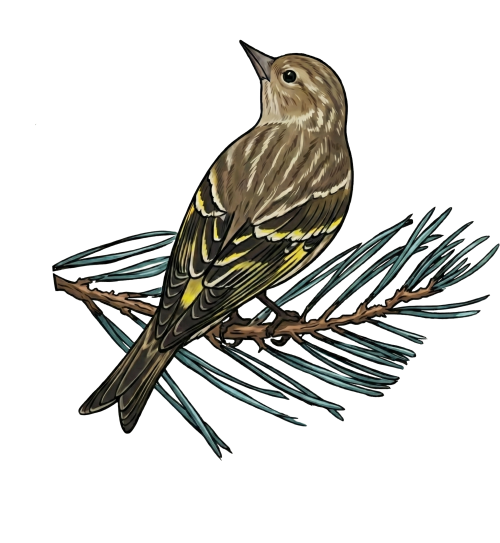
This winter could be different, though. The winter finch forecast predicts that more Pine Siskins, Purple Finches, Common Redpolls and Red-breasted Nuthatches will make their way south this year than did last year. Keep an eye out for them. To add to the excitement, sometimes in the winter we might get an unexpected visitor from the West such as a Bullock’s Oriole, an Ash-throated Flycatcher, or a wintering hummingbird. It is definitely worth your while to bundle up and join a winter field trip or even better, participate in a Christmas Bird Count. Birding adventures await!
— Larry Meade
MICHIGAN BIRDING
This past June I traveled to Michigan in search of the Kirtland’s Warbler, one of the rarest birds in North America. The most reliable place to find this bird is in the young jack pine forests in the central part of the state. Kirtland’s Warblers can only breed in this specific habitat and the loss of jack pines of the proper size was a huge factor in nearly driving Kirtland’s Warblers to extinction. It is estimated that in the 1970s there were less than five hundred individual birds left.
Another major cause of the decline of these warblers has been nest parasitism by Brown-headed Cowbirds. At one point the rate of cowbird parasitism in Kirtland’s Warbler nests was an astounding 71 percent. The conservation effort to save this beautiful bird has been a great success story. Land has been set aside for the birds to breed in and proscribed burns have been utilized to clear away old jack pines to make room for young trees suitable for the warblers. Fire also allows the jack pine cones to open and spread their seeds. Through the use of traps, the Brown-headed Cowbird problem has also been dealt with. Thousands of birds are caught every year and sent to cowbird heaven causing parasitism rates to fall to five percent. Now it is estimated that there are around five thousand Kirtland’s Warblers.
In late June, I showed up at the visitor center at Hartwick Pines State Park in Grayling, Michigan. This is from where the tour to see the Kirtland’s Warblers would originate. Evening Grosbeaks on the feeders just outside the windows told me that I was not in Virginia anymore. After a short video presentation about the warblers, we carpooled out to see them. We had no trouble finding them. In fact we heard one singing as soon as we took a few steps from the cars. We ended up getting nice looks at several Kirtland’s Warblers including a female.
Flushed with success at seeing a much sought after life bird, I headed up to the Upper Peninsula of Michigan to explore the boreal forest. I stayed for two nights at a lodge at Trout Lake. One of my goals was to hear and maybe see a Connecticut Warbler since they are known to breed in that area. I had no luck with finding this bird, but I did find another life bird. I was driving down a forest road when I saw a Spruce Grouse standing in the road. This is a bird I had missed on my trip to Maine. I also noticed that there were several baby grice (grouslings?) running around. I hopped out of my car in hopes of getting a photo of the mother, but I was afraid she would take off before I got a chance. The bird just stood there and posed for me at close range. I appreciate her cooperation!
Other highlights of the trip included eleven other warbler species, a singing Purple Finch, Sandhill Cranes and some new butterfly and dragonfly species for my lists. On the way back to catch my flight home from Lansing, I stopped at the Chippewa Nature Center in Midland. I definitely enjoyed my visit there. In addition to a modern nature center with a friendly staff, there are various tracts of land with different habitats to explore. I tallied 40 bird species including Blue-winged Warblers, Wild Turkeys and Baltimore Orioles. If you are planning to bird Michigan yourself, I recommend that you get A Birder’s Guide to Michigan by Chartier and Ziarno. I found it very helpful.
— Larry Meade
HIGHLAND COUNTY WINTER WEEKEND
Our winter trip to Highland County will be held on the weekend of February 27 to March 1 (Friday to Sunday). We will spend Friday night in Staunton and Saturday night in Highland County. The trip limit is 16 people. A complete description of the trip will be in the February 2015 edition of the Siskin. To sign up, call leader Elton Morel at (703) 553-4860 or email at eltonlmorel@verizon.net. NVBC membership is required.
— Elton Morel
Audubon Society of Northern Virginia Winter Waterfowl Survey
On Saturday, January 24 and Sunday, January 25, birders of all skill levels will join up to count waterfowl in Fairfax, Arlington, and Prince William counties, including the Potomac and Occoquan watersheds. Novice birders will be paired with expert bird enthusiasts. Larry Cartwright continues as the volunteer compiler for this year’s count. For more information and to join the team, email info@audubonva.org or call 703-438-6008.
eBirders: Practices and Changes
If you enter your bird sightings in eBird, you may have noticed a new category called Historical. eBird charactersizes this category this way: Birding was your primary purpose, but you cannot estimate start time, duration, and distance. Birders often have complete checklists of birds from their local area or trips abroad. These can be entered as Traveling or Stationary counts if reasonable estimates of start time, duration, and distance can be entered. This Historical protocol indicates that effort is uncertain, but birding was your primary purpose.
Jim Stasz of the Maryland and DC Birding group, offers these additional eBird tips, based on how the data is interpreted and used:
Don’t use zero in the count, to avoid having it interpreted as a “positive” hit by a computer mapping program just looking for anything in a box. A non-zero number or an X is fine.
Use X if you didn’t count an abundant species; don’t use 1. Do your best to count the abundant birds, but don’t misrepresent a count by using 1 when there were many.
Don’t use “complete” if you intentionally ignored common species.
— Jean Tatalias
CHRISTMAS BIRD COUNTS IN NORTHERN VIRGINIA
Sunday, December 14, 2014: MANASSAS-BULL RUN To participate, contact Audubon Society of Northern Virginia at info@audubonva.org or 703-438-6008.
Sunday, December 14, 2014: SENECA MD/VA Count has five Virginia sectors, ranging from Great Falls Park to the eastern corner of Loudoun County. To participate, email compiler Jim Nelson at kingfishers2@verizon.net.
Sunday, December 14, 2014: THE PLAINS/AIRLIE To participate, email compilers, Todd Day at blkvulture@aol.com or Perri Borowiecki at pborowiecki@comcast.net.
Saturday, December 20, 2014: WASHINGTON D.C. Includes area of Virginia inside the Beltway along with Dyke Marsh. To participate, email compiler, Larry Cartwright: prowarbler@verizon.net or contact the Audubon Naturalist Society through Carol Hayes at carol.hayes@anshome.org or call 301-652-9188 extension 10.
Saturday, December 27, 2014: CENTRAL LOUDOUN Sign up at www.loudounwildlife.org or contact compiler, Joe Coleman: 540-554-2542 or joecoleman@rstarmail.com.
Sunday, December 28, 2014: NOKESVILLE For more information or to register, contact Kim Hosen at 703-499-4954 or khosen@pwconserve.org.
Sunday, December 28, 2014: SUGARLOAF MOUNTAIN Lucketts Sector is in northern Loudoun County. To participate contact sector leader, Joanna Taylor: 703-243-5989 or jandrtaylor@verizon.net.
Sunday, January 4, 2015: CALMES NECK Parts of western Loudoun and eastern Clarke counties. The cutoff date to join up to participate is December 21. Contact compiler, Margaret Wester: at margaretwester@hotmail.com.
Sunday, January 4, 2015: FORT BELVOIR Contact compiler, Kurt Gaskill at kurtcapt87@verizon.net or 703-768-2172.
Sunday, January 4, 2015: WALKERTON Count area is primarily in Middle Peninsula. Contact by December 21. Contact compiler, Fred Atwood: fredatwood@yahoo.com.
Club Announcements
NVBC eMail Exchange: To receive email notices, join the NVBC eMail Exchange. Send an email to nvbc-exchange-subscribe@googlegroups.com.
Trips and Events: Beginning birders are welcome on all trips. When reservations are required, please call one of the trip leaders. If in doubt about a trip because of weather, please call one of the leaders. Check the NVBC website for updated information about trips: www.nvabc.org/trips.htm.