April 2018
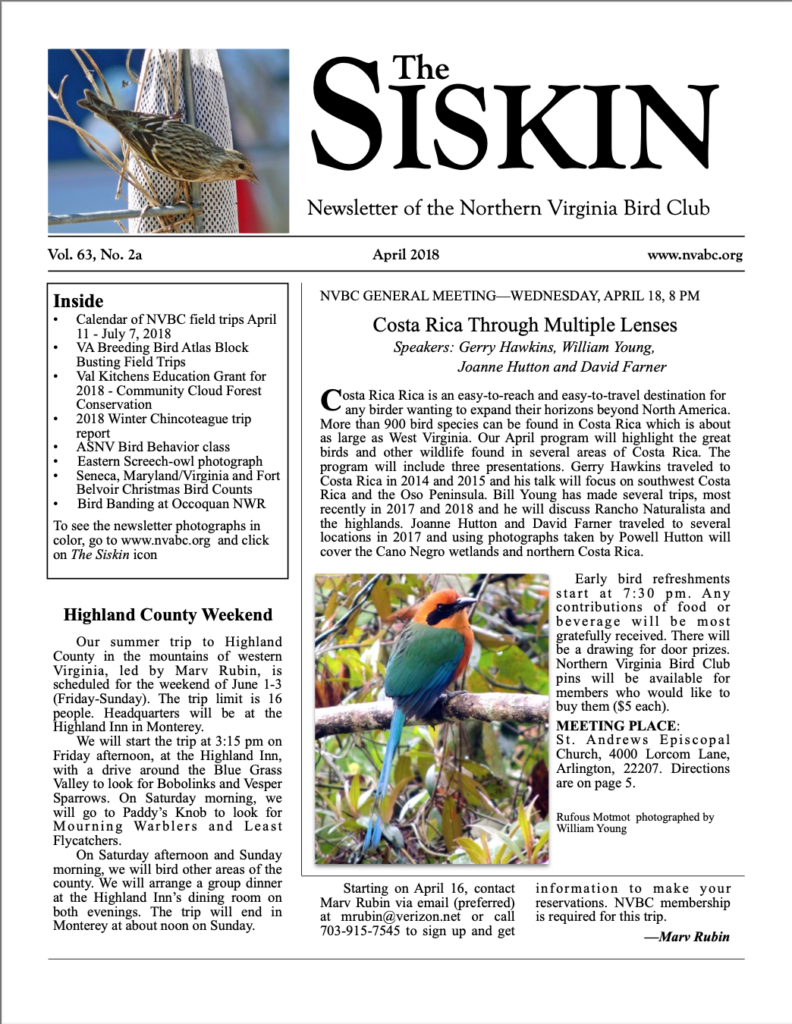
The SISKIN: Newsletter of the Northern Virginia Bird Club
Vol. 63, No. 2 — April 2018
Inside
Calendar of NVBC field trips April 11 – July 7, 2018
VA Breeding Bird Atlas Block Busting Field Trips
Val Kitchens Education Grant for 2018 – Community Cloud Forest Conservation
2018 Winter Chincoteague trip report
ASNV Bird Behavior class
Eastern Screech-owl photograph
Seneca, Maryland/Virginia and Fort Belvoir Christmas Bird Counts
Bird Banding at Occoquan NWR
Highland County Weekend
Our summer trip to Highland County in the mountains of western Virginia, led by Marv Rubin, is scheduled for the weekend of June 1-3 (Friday-Sunday). The trip limit is 16 people. Headquarters will be at the Highland Inn in Monterey. We will start the trip at 3:15 pm on Friday afternoon, at the Highland Inn, with a drive around the Blue Grass Valley to look for Bobolinks and Vesper Sparrows. On Saturday morning, we will go to Paddy’s Knob to look for Mourning Warblers and Least Flycatchers. On Saturday afternoon and Sunday morning, we will bird other areas of the county. We will arrange a group dinner at the Highland Inn’s dining room on both evenings. The trip will end in Monterey at about noon on Sunday.
+4
Starting on April 16, contact Marv Rubin via email (preferred) at mrubin@verizon.net or call 703-915-7545 to sign up and get information to make your reservations. NVBC membership is required for this trip. —Mary Rubin
+2
NVBC GENERAL MEETING — WEDNESDAY, APRIL 18, 8 PM
Costa Rica Through Multiple Lenses
Speakers: Gerry Hawkins, William Young, Joanne Hutton and David Farner
Costa Rica is an easy-to-reach and easy-to-travel destination for any birder wanting to expand their horizons beyond North America. More than 900 bird species can be found in Costa Rica which is about as large as West Virginia. Our April program will highlight the great birds and other wildlife found in several areas of Costa Rica. The program will include three presentations. Gerry Hawkins traveled to Costa Rica in 2014 and 2015 and his talk will focus on southwest Costa Rica and the Oso Peninsula. Bill Young has made several trips, most recently in 2017 and 2018 and he will discuss Rancho Naturalista and the highlands. Joanne Hutton and David Farner traveled to several locations in 2017 and using photographs taken by Powell Hutton will cover the Cano Negro wetlands and northern Costa Rica.
+4
Early bird refreshments start at 7:30 pm. Any contributions of food or beverage will be most gratefully received. There will be a drawing for door prizes. Northern Virginia Bird Club pins will be available for members who would like to buy them ($5 each).
+2
MEETING PLACE: St. Andrews Episcopal Church, 4000 Lorcom Lane, Arlington, 22207.
Presidential Peentings
I am excited about a couple of projects that the Northern Virginia Bird Club will be more involved with this year. The Second Virginia Breeding Bird Atlas is in its third year. VABBA2, as it’s known for short, is a five-year project cosponsored by the VDGIF and the VSO, which is endeavoring to document as many breeding birds in as many places in Virginia as possible. It is all done through eBird and hundreds of birders throughout the state have been getting out in the field and recording their observations. Up to this point, many birders from the NVBC have been assiduously atlasing and have contributed a significant amount of valuable data.
+4
Now we want to take our efforts to the next level. Last summer there was a successful impromptu “block busting” event where several birders covered a priority atlas block near Merrimac Farm in Prince William County. This year we have scheduled some more block busting trips to parts of Virginia that also need help. Some will be local and some will be farther afield. Everyone is welcome to join us in what should prove to be a meaningful contribution to the atlas and to citizen science.
+4
I also want to mention that we as a club have decided to help students in Guatemala attend a Kids and Birds camp. We will be awarding Community Cloud Forest Conservation (CCFC) a $500 “Val Kitchens Educational Grant” which will fund an entire class for a week. Thanks to all of the Northern Virginia birders who are helping to make these worthwhile undertakings possible. —Larry Meade
+3
Virginia Breeding Bird Atlas Block Busting Field Trips
Two Saturday and two Wednesday trips are planned for June (and a potential follow up in early July) to contribute to the Virginia’s Second Breeding Bird Atlas (the first took place over 30 years ago). Although the locations will not be determined until May (and will be communicated via the NVBC web site, email exchange and Facebook page), we are tentatively scheduling the trips on June 20, 23, 27 and 30, with potential follow up (for interested parties) on July 7. On a trip day, our group will meet at a pre-arranged site at the priority block location and Atlas the whole block by splitting into two or three groups, starting at 7 am. Our efforts should net at least 10 new confirmations for each of the blocks. Participants may consider joining NVBC field trips in April and May as these will also present some of the ways we identify breeders and potential breeders for the Atlas. Join in and help this state-wide effort that is now in its third year (out of five)! Thank you! POC is Kurt Gaskill, kurtcapt87@verizon.net and 202-767-3098.
+4
The Val Kitchens Education Grant for 2018 — Community Cloud Forest Conservation
The NVBC Board is proud to announce that this year the annual Val Kitchens Educational Grant, renamed from the Val Kitchens Memorial Scholarship, has been awarded to Community Cloud Forest Conservation (CCFC) in Guatemala to support their “Kids and Birds” program. Our $500 grant is being matched by another donor so NVBC’s grant will provide double the impact. Since 2012, CCFC in partnership with Cornell Lab of Ornithology has been teaching kids about birds. This program focuses on schools within two Important Bird Areas in the cloud forest region of the Guatemalan central highlands. Kids & Birds uses Cornell’s BirdSleuth curriculum, “Aves en mi Mundo,” a ten-lesson unit in Spanish which introduces kids to conservation biology, citizen science and ecology through birds. CCFC plans to provide the program to 1,200 students between January and September 2018. NVBC’s $500 provides the funding needed for a class of sixth graders from a local school to participate in the program and spend 4 days on site including meals.
+4
The communities around CCFC’s site in the Alta Verapaz department are primarily Q’eqchi’ Mayan and live in or adjacent to cloud forest. Unfortunately, Guatemalan cloud forest, as with cloud forest in most parts of the world, is rapidly disappearing as populations grow and more land is cleared for pasture or corn. These Guatemalan cloud forests are home to regional endemic species such as Highland Guan, Black-throated Jay, and Slate-colored Solitaire. But cloud forest also provides important wintering grounds for neotropical migrants like Wood Thrush, Black-throated Green and Golden-cheeked Warblers. Raising awareness about the importance of the cloud forest ecology especially among young people in the communities in the area is a critical part of conservation effort.
+4
I was introduced to CCFC in January as part of a trip organized by Pennsylvania’s Conococheague Audubon Society. The trip was intended to be a combination of birding in Guatemala and conducting reforestation plantings on previously cleared cloud forest lands. Our group managed to get in quite a bit of birding and did some planting but we ended up spending two days birding with local fifth and sixth graders. The students spent time learning the basics of birding such as bird behavior, topography and plumage using Cornell’s curriculum. Then each birder went out in the field to bird with three kids. We overcame language barriers by using field guides and picking up a little of each other’s language as we went along.
+4
My group managed to find some nice local birds like Blue-and-white Mockingbird and Lesson’s Motmot, but the girls’ favorite seemed to be a Squirrel Cuckoo we saw well. The girls would laugh each time someone said “squirrel cuckoo.” After all whether you speak Q’eqchi’ or English it is a fun combination of words! On our second day with the kids we went into a local town for some lakeside birding at Laguna Chichoj in San Cristóbal Verapaz. We saw lots of “our” birds such as Ospreys, Spotted Sandpipers, and Yellow and Wilson’s Warblers but the highlight was a Spotted Rail. Unlike most rail sightings, this bird stayed in one spot on a little island long enough for 12 Americans and 18 kids, plus a few parents to all get excellent scope views. Laguna Chichoj is one of only two places in Guatemala where Spotted Rail has been found. The following day at CCFC 36 local school teachers came out to learn about birds and in the afternoon, we again divided into groups. Some of the teachers I birded with knew a bit about birds but few had used binoculars to look at them, so seeing colorful birds such as Crimson-collared Tanager and Slate-throated Redstarts elicited several “oohs” and “ahhs.” Community Cloud Forest Conservation has a great program underway to educate young people and preserve cloud forest. I’m lucky to have visited and proud that the Northern Virginia Bird Club will be providing assistance to their program. —David Farner
+4
Chincoteague Winter Trip: Eurasian Wigeon, Snow Bunting and Common Eider
The Northern Virginia Bird Club visited the Chincoteague National Wildlife Refuge (NWR) and the Chesapeake Bay Bridge and Tunnel (CBBT) Complex on the weekend of February 2 to 4. The trip was led by Marc Ribaudo and me. We collectively tallied 91 species for the weekend. That is a bit on the low side—usually we get about 100 species. I think the combination of cold temperatures and frozen water really limited the variety of birds in the Chincoteague area, especially our ability to find many shorebirds and passerines.
+2
Nevertheless, we found some good birds. On Friday afternoon, we were confronted with brisk winds gusting over 20 miles per hour. Our drive around the Wildlife Loop was fairly uneventful except for a quick flyby of a Merlin and a Northern Harrier. A quick drive out to the beach resulted in a nice look at an adult Lesser Black-backed Gull amongst the other loafing gulls. Overnight, the wind died down enough such that Saturday turned out to be a much more bearable day of birding. Our best bird was a male Eurasian Wigeon in Swan Cove. It was really difficult to get a good look at the bird since it was sleeping amongst a flock of other ducks hunkered down from the wind. Other highlights were a large flock of Snow Geese that flew over our heads, and White-winged Scoters and Long-tailed Ducks in Tom’s Cove. A visit to feeders at Marv Rubin’s home resulted in nice looks at Brown-headed Nuthatches and a Pine Warbler.
+4
Much better weather greeted us on Sunday morning. At Kiptopeke State Park, two Snow Buntings showed very well for us in the grass and also perched on top of the gazebo at the fishing pier. We also had outstandingly close looks at two Red-throated Loons just off the pier. The new construction project at the CBBT has shut down islands number one, two and three, so we were limited to visiting only island number four. We were originally scheduled to start our tour at noon, however, an impending rainstorm encouraged us to change our plans and start earlier at 11am. Our highlight find was an immature male Common Eider amongst the Black and Surf Scoters, flybys of many Northern Gannets, Great Cormorants perched on the abutments of the bridge and a small flock of Purple Sandpipers on the rocks joined by a Ruddy Turnstone. Just as our one hour at the island was ending, the rain began in earnest thus ending our birding weekend. —Elton Morel
+4
ASNV Bird Behavior class with Bill Young
A class sponsored by Audubon Society of Northern Virginia May 1, 8, 15 and 22 Edison High School
Bill Young will lead us in four two-hour sessions examining a variety of bird behaviors, including avian feeding, reproduction, migration, visual and auditory displays, and more. Classes will draw from bird behavior Bill has observed on seven continents. The class includes one field trip. Check audubonva.org/classes for more details about this and other classes.
+3
Christmas Bird Count (CBC) Reports
Seneca, Maryland/Virginia Christmas Bird Count, December 17, 2017 We had seasonable weather on count day for this 59th Seneca CBC. Each year, the count is done in a 15-mile diameter count circle, centered at Violette’s Lock on the C&O Canal, and includes areas of Montgomery, Fairfax, and Loudoun counties. The count circle is divided into 16 sectors (5 in Virginia comprising about 40 percent of the circle, and 11 in Maryland covering the other 60 percent). Our 135 intrepid counters found 98 species on count day, above the 96 average for the previous 10 years. Ten additional species were only found during “count week” for a grand total of 108 species. The 34,015 individual birds counted are the highest total since 2007.
+4
Most notable were a Eurasian Wigeon and a LeConte’s Sparrow that may well be the same two birds that were the first ever for our count last year. In addition, counters found 2 Sandhill Cranes, a Ring-necked Pheasant, a Rough-legged Hawk, and an American Woodcock. Notable results include new all-time highs with 55 Tundra Swan, 178 Pileated Woodpecker, and 4 Merlin. On the other end of the spectrum are the low counts: Red-tailed Hawk (lowest since 1969!), Rock Pigeon, no Red-breasted Nuthatch, Brown Creeper (lowest since 2000), no American Pipit, and only one Pine Siskin. —Jim Nelson, Compiler
+4
Fort Belvoir Christmas Bird Count, December 31, 2017 Despite temperatures just above 20°F and an occasional breeze the count did well with a total of 112 species. We tallied 86,675 individual birds. Unusual and/or notable species were: Cackling Goose, Eurasian Wigeon, Long-tailed Duck, Great Egret, Merlin, Lesser Yellowlegs, Glaucous Gull, Common Raven, American Pipits, Yellow Warbler, Clay-colored Sparrow, Lincoln’s Sparrow and 2 Pine Siskin. High counts were Merlin (4), Yellow-bellied Sapsucker (100), Common Raven (8), and White-throated Sparrow (4,911). Low Counts were Carolina Chickadee (692) and Tufted Titmouse (579) probably due to cold conditions. —Kurt Gaskill, Compiler
+4
Bird Banding at Occoquan Bay NWR
The bird banding station at Occoquan Bay NWR will open to visitors starting March 25. The station will be open Wednesdays, Fridays, Saturdays and Sundays from 7 am to 11:30 am. The season lasts until the end of May. The station is located on Deephole Point Road overlooking Marumsco Creek.
+1
Club Information & Contacts
Join the Northern Virginia Bird Club: Northern Virginia Bird Club dues for 2018 are $10 for Individual and $15 for Family Membership. Checks for dues should be sent to: NVBC, P.O. BOX 5812, ARLINGTON, VA 22205-0812.
+2
President: Larry Meade, 703-206-9030
Vice President, Programs: David Farner, 443-643-6141
Vice President, Field Activities: Elton Morel, 703-553-4860
Secretary: Diane Marton, 703-527-7360
Treasurer: Jean Tatalias, 703-281-6099
10% Birder Discount: Mention NVBC membership at Birdwatchers Seed and Supply Company, 396 Maple Avenue East, Vienna.