April 2019
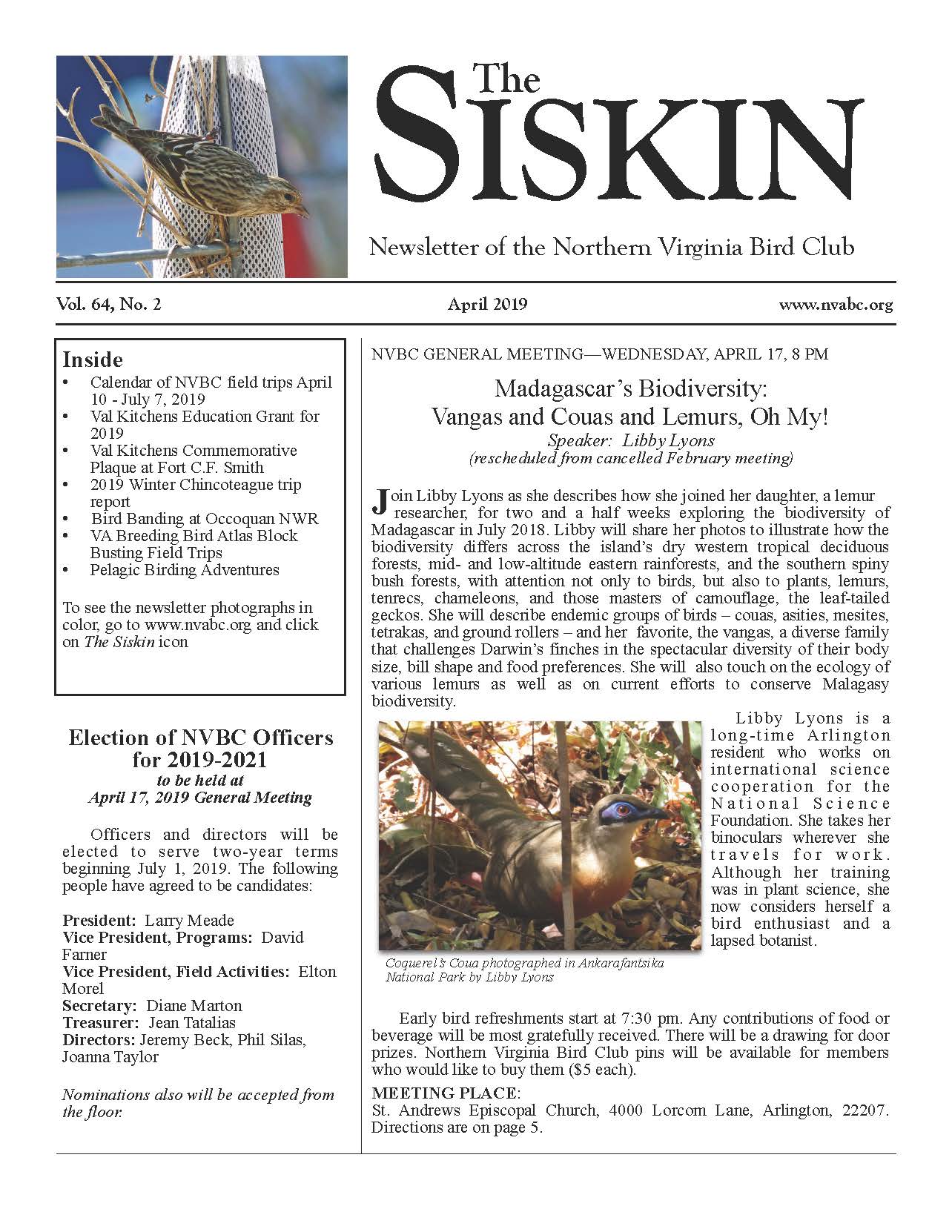
THE SISKIN
Newsletter of the Northern Virginia Bird Club Vol. 64, No. 2 — April 2019
NVBC GENERAL MEETING—WEDNESDAY, APRIL 17, 8 PM
Madagascar’s Biodiversity: Vangas and Couas and Lemurs, Oh My! Speaker: Libby Lyons (rescheduled from cancelled February meeting)
Join Libby Lyons as she describes how she joined her daughter, a lemur researcher, for two and a half weeks exploring the biodiversity of Madagascar in July 2018. Libby will share her photos to illustrate how the biodiversity differs across the island’s dry western tropical deciduous forests, mid- and low-altitude eastern rainforests, and the southern spiny bush forests, with attention not only to birds, but also to plants, lemurs, tenrecs, chameleons, and those masters of camouflage, the leaf-tailed geckos. She will describe endemic groups of birds – couas, asities, mesites, tetrakas, and ground rollers – and her favorite, the vangas, a diverse family that challenges Darwin’s finches in the spectacular diversity of their body size, bill shape and food preferences. She will also touch on the ecology of various lemurs as well as on current efforts to conserve Malagasy biodiversity.
Libby Lyons is a long-time Arlington resident who works on international science cooperation for the National Science Foundation. She takes her binoculars wherever she travels for work. Although her training was in plant science, she now considers herself a bird enthusiast and a lapsed botanist.
Early bird refreshments start at 7:30 pm. Any contributions of food or beverage will be most gratefully received. There will be a drawing for door prizes. Northern Virginia Bird Club pins will be available for members who would like to buy them ($5 each).
MEETING PLACE: St. Andrews Episcopal Church, 4000 Lorcom Lane, Arlington, 22207.
Presidential Peentings
By Larry Meade
For many birders, getting together with others who share our interests is one of the great attractions of the hobby. Perhaps the ultimate way to bird together is to participate in a birdathon where a team of birders try to identify as many bird species as possible within a twenty-four hour timeframe. Usually, this effort is a way to raise money for a bird club or conservation organization. There are generally several teams competing against each other and prizes often are awarded to the team that spots the most birds.
For several years, I have been competing on a birdathon team called the Raven Loonatics. We raise money for the Loudoun Wildlife Conservancy and usually do pretty well. More importantly, we enjoy the comradery and competition that the birdathon provides. Over the years, we have honed and refined our route which must stay within the confines of Loudoun County. One key to success is to visit as many types of habitats as possible in order to encounter the greatest diversity of bird species. We know spots for waterfowl, shorebirds, warblers, marsh birds, etc.
You can get involved by joining an existing birdathon team or by forming your own team. Be aware that it is a tradition to come up with a team name that is also a bird pun. The more painful the pun, the better! Another way to support a birdathon by making a monetary pledge to a team that will be out in the field finding those birds. These pledges can be a flat sum or on a per bird basis. Birdathons are a great way to enhance your birding skills while raising much needed funds for worthy organizations. A Birdathon day can be long and arduous at times, but it’s well worth the effort.
Val Kitchens Education Grant for 2019
By David Farner
Once again in 2019 the NVBC Board is proud to award the annual Val Kitchen’s Education Grant to Community Cloud Forest Conservation (CCFC) in Guatemala to support their “Kids and Birds” program
. The $500 grant will provide the funding for a class of sixth-graders from a Q’eqchi’ Maya primary school in the cloud forest to take part in Cornell Lab of Ornithology’s “BirdSleuth” international curriculum for four days at CCFC, including room and board. CCFC’s “Kids and Birds” environmental education program not only teaches students about birds; it also introduces stream ecology and agroecology. Students participate in reforestation of cloud forest and planting of agroforestry parcels. Students also get to use bio-acoustic equipment to record nature sounds in the cloud forest.
In 2018 I was able to participate in this program while visiting CCFC and kept thinking I wish I had learned about birds like this when I was in sixth-grade! CCFC was also awarded the grant in 2018. You may remember Rob Cahill, Director of CCFC from our September 2018 meeting when he spoke about the Birds, Birding and Conservation in Guatemala. Rob and his wife Tara visited with me briefly in February and also stopped in to visit the NVBC Board during the February meeting to express their gratitude for NVBC’s continued support. All donations to the Club in fiscal year 2018-2019 goes to the Education Grant and Scholarship program. As of March 20, 2019, $570 has been contributed.
Val Kitchens Commemorative Plaque
Dedicated to Valerie Kitchens (1937-2013) who championed the creation of this water feature. Peter Ross, NVBC member, photographed the commemorative plaque that honors Val Kitchens for her work in creating the Fort C. F. Smith water feature. Peter worked with Arlington County and shared the cost with the Club to provide this memorial.
2019 Winter Chincoteague Trip Report
By Elton Morel
The annual Chincoteague trip was a weekend of weather extremes starting with a snow storm on Friday afternoon and ending with balmy temperatures and placid waters at the Chesapeake Bay Bridge and Tunnel (CBBT) Complex on Sunday
. The Northern Virginia Bird Club visited the Chincoteague National Wildlife Refuge (NWR) and the CBBT on the weekend of February 1 to 3, led by Larry Cartwright and me. We collectively tallied 94 species for the weekend.
On Friday afternoon, some participants navigated through a snow storm en route. After orientation, we headed out to the Wildlife Loop on the refuge and started sorting through many ducks; the best find being Green-winged Teals. It started snowing again and by the time we made it all the way around the loop, it got heavy. We tried to show the group three sleeping Redheads in Swan Cove, but the snow was falling so hard we gave up an hour early.
Saturday was nice and sunny. We re-found the three Redheads and a pair of Mute Swans, along with large flocks of Snow Geese and Tundra Swans. On the ocean side, we enjoyed large numbers of Northern Gannets and saw two frequently diving Red-necked Grebes. Saturday afternoon activities included a visit to the Queen Sound boat launch where we had excellent looks at American Oystercatchers, Long-tailed Ducks, Common Goldeneyes, a juvenile Black-crowned Night-heron and a spectacular flyover of a large flock of Brants.
Sunday morning was a glorious, balmy day. At Kiptopeke State Park, we had amazingly close views of all three species of scoters including a male Black Scoter and a show-stopping male White-winged Scoter. At CBBT Island #4, we spotted Great Cormorants, Purple Sandpipers, and gleaming Northern Gannets. Just as we were about to finish, a Razorbill flew in and we all got wonderful looks at this curious looking alcid.
Bird Banding at Occoquan Bay NWR
The bird banding station at Occoquan Bay NWR will open to visitors starting March 27. The station will be open Wednesdays, Fridays, Saturdays and Sundays from 7 am to 11:30 am until the end of May. The station is located on Deephole Point Road overlooking Marumsco Creek.
VA Breeding Bird Atlas Block Busting Field Trips
Block Busting field trips are planned for June 29 and July 7 to contribute to Virginia’s Second Breeding Bird Atlas. Our group will meet at a pre-arranged site at the priority block location and Atlas the whole block by splitting into groups starting at 7 am. Our efforts should net at least 10 new confirmations for each block. Join in and help this state-wide effort now in its fourth year! POC is Kurt Gaskill.
Pelagic Birding Adventures
By Larry Meade
Birders trek to wetlands, forests and beaches, but not everyone thinks of the open ocean, also known as the pelagic zone, as a prime birding habitat. However, there are often many birds out there that can rarely be found close to shore. A boat journeying out to find pelagic birds will leave before sunrise. Experienced spotters help participants find and identify birds using a clock system. Some birds found in warmer months include Wilson’s Storm-Petrels, Corey’s Shearwaters, Black-capped Petrels, and Bridled Terns.
I once saw a Cape Verde Shearwater near the Gulf Stream which turned out to be a first North American record. In the west, there are trips that explore the Pacific; I took a trip out of Westport, Washington and found Black-footed and Laysan Albatross. You might also choose a trip in the winter to see a Great Skua, though these are not for the faint of heart due to rougher seas
. While seabirds are the main attraction, you may also encounter whales, dolphins, or sea turtles
. I once saw a Northern Right Whale in Virginia waters and a Leatherback Sea Turtle that looked like the size of a small Volkswagen.
Election of NVBC Officers for 2019-2021
To be held at the April 17, 2019 General Meeting
The following candidates have agreed to serve two-year terms beginning July 1, 2019:
President: Larry Meade
Vice President, Programs: David Farner
Vice President, Field Activities: Elton Morel
Secretary: Diane Marton
Treasurer: Jean Tatalias
Directors: Jeremy Beck, Phil Silas, Joanna Taylor
Club Contacts
President: Larry Meade, 703-206-9030
Vice President, Programs: David Farner, 443-643-6141
Vice President, Field Activities: Elton Morel, 703-553-4860
Secretary: Diane Marton, 703-527-7360
Treasurer: Jean Tatalias, 703-281-6099
Next Board Meeting: Thursday, June 6, 2019, 7:30 pm, at Diane Marton’s home.